
Bayer seizes on an opportunity to end a flood of lawsuits over the cancer-glyphosate link, even while 80 percent of Americans tested are peeing out residues of the toxin.
Linda Bonvie
Big Ag’s long-held desire to capitalize without culpability might be fulfilled this year.
This spring, the Supreme Court will hear a case with widespread implications that may effectively eliminate liability if a chemical manufacturer fails to warn the public about the hazards of toxic products.
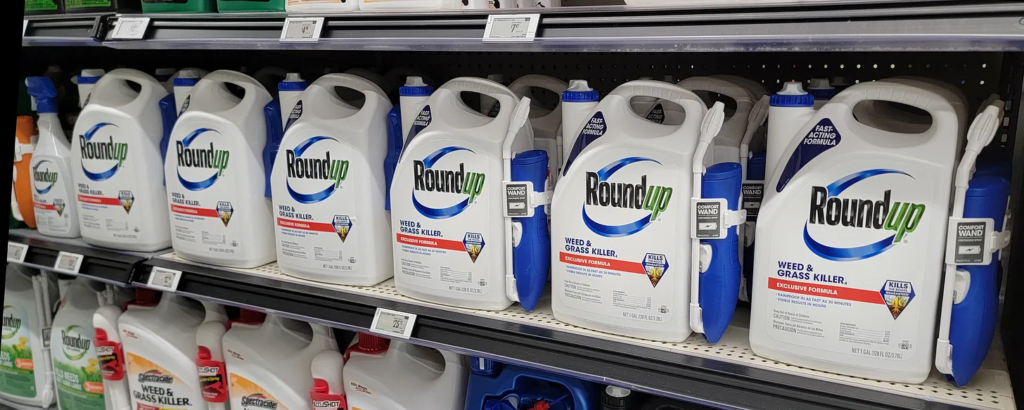
The case before the high court, Monsanto v. Durnell, stems from John Durnell’s 2019 lawsuit that maintained exposure to the chemical glyphosate in Monsanto’s Roundup herbicide caused his non-Hodgkin lymphoma. The jury agreed Monsanto knew, or should have known, but failed to warn him of the risk and awarded Durnell $1.25 million in damages.
The upcoming question before the Supreme Court is basically, once the label (no matter how old or deficient it is) for a bug or weed killer is OK’d by the U.S. Environmental Protection Agency, can citizens still sue in state courts for failure to warn of risks the manufacturer is, or should have been aware of?
Twenty-one years ago, the Supreme Court already answered “yes” to that question after a group of peanut farmers sued chemical giant Dow. But the German chemical company Bayer, which purchased Monsanto, along with its trademark weed-killer, in 2018, has stated it will do whatever is necessary to “manage and mitigate the risks of Roundup litigation in the U.S.”
What Bayer would also love to do away with are millions of pages of documents that came to light in the very first Roundup cancer trial, which has been described as “one of the most significant exposures of corporate malfeasance in modern history.”
The “Monsanto Papers”
The voluminous findings uncovered during legal discovery in the initial Roundup cancer case of Johnson v. Monsanto, which came to trial in 2018, have come to be known as the “Monsanto Papers,” which offer a fly-on-the-wall look at Monsanto’s shady operations that became prime evidence in scores of later lawsuits over glyphosate and cancer.
The company acted so high and mighty in dealing with Johnson’s legal team, telling them literally to “go away,” that it neglected to file the necessary documents to keep many of the papers confidential. The trove of classified material subsequently released, said Johnson’s lawyers at Wisner Baum, showed “a systematic, decades-long campaign by the agrochemical giant to manipulate scientific research, corrupt regulatory processes, and deceive the public about the safety of its flagship herbicide, Roundup.”
Monsanto, the papers revealed, had a long history of scientific manipulation, ghostwriting “studies” for scientific journals supposedly authored by independent researchers (including one that was frequently used as evidence of glyphosate safety published in 2000 but was retracted late last year due to “serious ethical concerns.”)
The company also engaged in what Johnson’s attorneys call “regulator capture at the highest levels,” coordinating with industry-friendly officials at the EPA to suppress information. One such official in particular, by the name of Jess Rowland, who was the lead in the agency’s cancer-risk assessment, was found to have “coordinated with Monsanto to suppress independent safety reviews.”
The Monsanto Papers likewise disclosed the existence of its “Intelligence Fusion Center,” a spy operation that tracked and kept tabs on those in the media, academia, and environmental groups who were critical of Monsanto and Roundup. As Dr. David Schubert, head of the Salk Institute for Biological Studies’ Cellular Neurobiology lab, put it, “Monsanto and other agricultural chemical companies lied about their products, covered up the damaging data, and corrupted government officials in order to sell their toxic products around the world.”
Of course, if the Supreme Court had ruled the other way over 20 years ago on the same question that’s coming around again, we would never have been privy to any of those once-confidential secrets. A company-authored paper published in Regulatory Toxicology and Pharmacology that was cited hundreds of times as proof that glyphosate is harmless would never have been retracted, and glyphosate would never have been removed from garden center Roundup products – a concession Bayer says has nothing to do with safety concerns, but is simply to “manage litigation risk.” (Glyphosate is still easy for consumers to find, however, and widely used in so-called Roundup “pro” versions as well as other brand names, since the chemical’s patent has now expired.)
Glyphosate is considered to be the most widely used weed killer in “the history of chemical agriculture,” with Roundup Ready and other brands of genetically modified crops having played a major part in that.
Meanwhile, back at Bayer headquarters
If you had no prior knowledge of Bayer, Monsanto, or Roundup and happened to land on the Bayer Global website, you might be convinced that Bayer adores farmers, “science is boss,” and the company has been taken to the slaughterhouse by the “litigation industry.”
A press release the company issued in January gushed over the chance of a victory at the Supreme Court not only being part of its “multi-pronged strategy” to “contain” the ongoing lawsuits, but also as “good news for U.S. farmers.”
Unfortunately, bad news for farmers, along with everyone else who is exposed to glyphosate, has continued to be released.
For example, in 2015, the World Health Organization’s IARC – International Agency for Research on Cancer – listed glyphosate as “probably carcinogenic to humans.”
In fact, a 2019 study published by researchers from the Icahn School of Medicine at Mount Sinai in New York, the University of Washington, the School of Public Health in Seattle, and the University of California found that exposure to glyphosate increases the risk of non-Hodgkin lymphoma by over 40 percent.
A study published in 2022 by researchers at the Department of Health Sciences at the Universidade de Vigo in Spain revealed that “…exposure to glyphosate or its commercial formulations induces several neurotoxic effects.” If that’s not scary enough, the scientists found it can do so at amounts that “…vary widely but are lower than the limits set by regulatory agencies.”
And just last year, researchers at the Ramazzini Institute (a nonprofit based in Bologna, Italy, specializing in long-term studies evaluating the cancer risks of environmental chemicals and food additives) found that not only does glyphosate cause multiple kinds of cancers from the liver to the bones to the bladder, but it can do so at levels considered “safe.” The principal researcher said the study “provides solid and independent scientific evidence of the carcinogenicity of glyphosate and glyphosate-based herbicides.”
Yet, the EPA continues to support Bayer in its mission to sell a cancer-causing chemical that the company insists is not only A-OK to use but prevents U.S. agriculture from suffering “dire” consequences.
Farmers, landscapers, and maintenance workers, however, are far from the only ones who may be harmed by glyphosate exposure.
It turns out, all you have to do is eat.
The flood of Frankenfoods
The introduction of “Roundup Ready” seeds (that were genetically modified not to die when directly sprayed with glyphosate as they emerge) in the late 1990s fueled the enormous increase in glyphosate use. The chemical is also used on fields before planting and on wheat and oats as a drying agent before harvesting. And glyphosate doesn’t disappear before these foods reach the consumer.
Confirmed by a 2022 report by the U.S. Centers for Disease Control and Prevention, glyphosate was found in the urine samples of over 80 percent of tested adults and kids. But that makes sense, as residues of the weed killer are found in a wide variety of foods, including oats, pasta, and wheat-based cereals.
While organically grown crops aren’t guaranteed to be 100 percent glyphosate-free due to factors such as spray “drift” or contaminated water, they are your best bet for avoiding exposure to the chemical, especially when consuming the top three genetically modified, glyphosate-drenched crops: soy, canola, and corn.
Although the EPA has set what it calls “allowable glyphosate residues,” supposedly safe tolerances on food for the chemical, the fact that large numbers of Americans – including kids — are peeing out residues doesn’t bode well for the safety of our food supply.
“Health for all, hunger for none.”
As Bayer advances its mission to continue to sell glyphosate and not be sued over it, company executives announced on Feb. 17 their desire to “free up our time and energy” to focus on saving the world, with a mission of “health for all, hunger for none.”
To that end, Bayer/Monsanto just made a class settlement offer (which it says “complements” the upcoming Supreme Court case) “to resolve current and future claims” of up to $7.25 billion over the course of 21 years.
The offer will require court approval.
Not that the offer is any sort of acknowledgement. In his breathless Tuesday investor pep talk, Bayer CEO Bill Anderson made sure to include what he called a worldwide “truth.”
“Glyphosate is safe to use.”
For more information on genetically modified crops, check out my book Badditives!
To learn more about the Monsanto Papers, see journalist Carey Gillam’s book, and watch the documentary on Lee Johnson called In the Weeds that is streaming on YouTube, Prime, and Apple TV.