The missing warnings

Hey Giant Food Stores, while you’re issuing “warnings” about milk ingredients, where’s the warning about the numerous excitotoxic (brain damaging) amino acids in the “food” you sell?

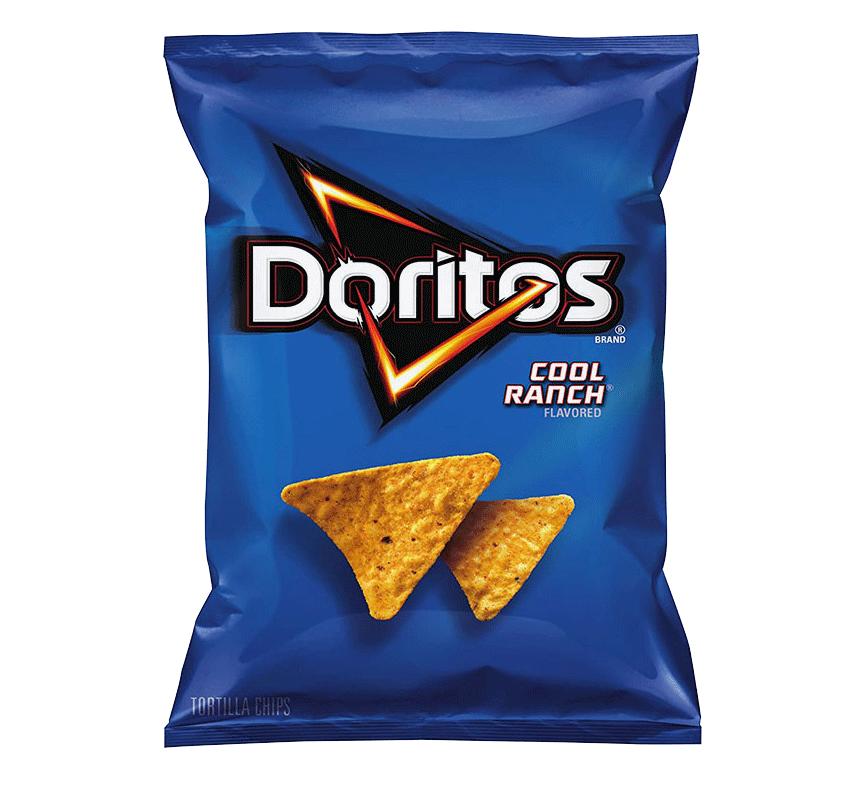
The warning and ingredient list below is from the Giantfoodstores.com grocery page to purchase the Frito-Lay variety pack. Only the ingredients that positively contain or create MfG (manufactured free glutamate) during processing are in red type. Disodium Inosinate and Disodium Guanylate, which work synergistically with MfG to intensify its actions, are noted as well.

Warnings 

 Doritos Cool Ranch Flavored Tortilla Chips, Doritos Nacho Cheese Flavored Tortilla Chips, Fritos Chili Cheese Flavored Corn Chips, Lay’s Sour Cream & Onion Flavored Potato Chips, Cheetos Crunchy Cheese Flavored Snacks: Contains milk ingredients. 

Product Disclaimer 

 GIANT is committed to providing accurate nutritional information to its customers. As an important part of that effort we voluntarily provide such material on our website. 

Ingredients 

Doritos Cool Ranch Flavored Tortilla Chips: Corn, Vegetable Oil (Corn, Canola, And/or Sunflower Oil), Salt, Corn Starch, Tomato Powder, Lactose, Whey, Skim Milk, Onion Powder, Sugar, Garlic Powder, Monosodium Glutamate, Maltodextrin (Made From Corn), Cheddar Cheese (Milk, Cheese Cultures, Salt, Enzymes), Dextrose, Malic Acid, Corn Syrup Solids, Buttermilk, Natural And Artificial Flavors, Sodium Acetate, Artificial Color (Red 40, Blue 1, Yellow 5), Spice, Citric Acid, Disodium Inosinate, And Disodium Guanylate.

Doritos Nacho Cheese Flavored Tortilla Chips: Corn, Vegetable Oil (Sunflower, Canola, And/or Corn Oil), Maltodextrin (Made From Corn), And Less Than 2% Of The Following: Salt, Cheddar Cheese (Milk, Cheese Cultures, Salt, Enzymes), Whey, Monosodium Glutamate, Buttermilk, Romano Cheese (Part-Skim Cow’s Milk, Cheese Cultures, Salt, Enzymes), Romano Cheese (Cow’s Milk, Cheese Cultures, Salt, Enzymes), Whey Protein Concentrate, Onion Powder, Corn Flour, Natural And Artificial Flavor, Dextrose, Tomato Powder, Lactose, Spices, Artificial Color (Yellow 6, Yellow 5, Red 40), Lactic Acid, Citric Acid, Sugar, Garlic Powder, Skim Milk, Red And Green Bell Pepper Powder, Disodium Inosinate, Disodium Guanylate, Potassium Chloride, And Sodium Caseinate.

Fritos Chili Cheese Flavored Corn Chips: Corn, Corn Oil, Whey, Salt, Spices, Maltodextrin (Made From Corn), Cheddar Cheese (Milk, Cheese Cultures, Salt, Enzymes), Canola Oil, Potassium Salt, Tomato Powder, Monosodium Glutamate, Onion Powder, Natural Flavors, Romano Cheese (Cow’s Milk, Cheese Cultures, Salt, Enzymes), Dextrose, Sugar, Buttermilk, Sodium Caseinate, Annatto Extracts, Butter (Cream, Salt), Citric Acid, Sunflower Oil, Garlic Powder, Disodium Inosinate, Disodium Guanylate, And Caramel Color.

Lay’s Sour Cream & Onion Flavored Potato Chips: Potatoes, Vegetable Oil (Canola, Corn, Soybean, And/or Sunflower Oil), Skim Milk, And Less Than 2% Of The Following: Salt, Whey, Onion Powder, Parsley, Sour Cream (Cultured Cream, Skim Milk), Dextrose, Maltodextrin (Made From Corn)., Natural Flavors, Medium Chain Triglycerides, Lactose, Citric Acid, Buttermilk, And Whey Protein Concentrate.

Lay’s Barbecue Flavored Potato Chips: Potatoes, Vegetable Oil (Canola, Corn, Soybean, And/or Sunflower Oil), Sugar, And Less Than 2% Of The Following: Dextrose, Salt, Maltodextrin [Made From Corn], Molasses, Torula Yeast, Onion Powder, Spices, Tomato Powder, Paprika, Natural Flavors, Corn Starch, Caramel Color, Yeast Extract, Paprika Extracts, Garlic Powder, And Mustard Seed Oil.

Cheetos Crunchy Cheese Flavored Snacks: Enriched Corn Meal (Corn Meal, Ferrous Sulfate, Niacin, Thiamin Mononitrate, Riboflavin, Folic Acid), Vegetable Oil (Corn, Canola, And/or Sunflower Oil), Cheese Seasoning (Whey, Cheddar Cheese [Milk, Cheese Cultures, Salt, Enzymes], Canola Oil, Maltodextrin [Made From Corn], Natural And Artificial Flavors, Salt, Whey Protein Concentrate, Monosodium Glutamate, Lactic Acid, Citric Acid, Artificial Color [Yellow 6]), And Salt.


For men only

As a man you probably don’t think about obesity being caused by pregnant women eating quantities of free glutamate in processed food.  But think again.  Because that same free glutamate ingested by pregnant women also lies at the root of the world’s infertility crisis.

True, infertility has many causes.  Failure to eat a healthy diet is one of them.  Breathing in toxic chemicals is another.  An accident could be the third.  But when a pregnant woman delivers more glutamate to her child during pregnancy then needed for normal development, the Jekyll and Hyde amino acid L-glutamate will destroy the part of the brain that was designed to oversee reproductive function.

Let me save you the trouble of trying to disprove this claim.  There are no data with which you can do that, first, because to date no one other than myself has considered that glutamate-induced brain damage plays a role in both the obesity epidemic and the infertility crisis.  Second, studies that allege to have demonstrated that monosodium glutamate is “safe” are flawed to the point of being fraudulent — as in using excitotoxic amino acids, which produce adverse reactions identical to those caused by MSG, in placebos.  It is the U.S. producer of the flavor-enhancer monosodium glutamate, not neuroscientists interested in the role of free glutamate in brain function, that have produced those badly flawed studies.

Should you have interest in reviewing data on the subject you’ll find it summarized in “Getting to the root of obesity”and spelled out in detail in “Glutamic acid: the Jekyll and Hyde molecule behind the obesity epidemic.”

And don’t be fooled by the titles of those papers.  Both infertility and obesity are caused by glutamate-induced brain damage done to the vulnerable brains of fetuses and newborns.   The mechanisms are identical.

Adrienne Samuels

Resources

Review of animal data offered inappropriately as evidence that MSG is harmless
https://www.truthinlabeling.org/assets/seven_lines/Seven_Lines_Lines3.pdf

Getting to the root of obesity”
https://www.truthinlabeling.org/assets/MASTERS_Perspective.pdf

Glutamic acid: the Jekyll and Hyde molecule behind the obesity epidemic” https://www.truthinlabeling.org/assets/Masters_obesity_review.pdf

Had they listened, the obesity epidemic would have been stopped before it took hold, and infertility would never have reached crisis proportions

Dr. John Olney

Sections below taken in part from the obituary of John W. Olney posted at Washington University in St. Louis, THE RECORD.

“John W. Olney, MD, the John P. Feighner Professor of Psychiatry and a professor of pathology and immunology, died April 14, 2015. He was 83.

“A longtime leader in the Department of Psychiatry at Washington University School of Medicine in St. Louis, Olney remained active in research until the last few days of his life.

“He studied neurotransmitters in the brain and how they can become toxic under certain circumstances. He was the first scientist to propose that when high concentrations of the neurotransmitter glutamate were released from brain cells, the glutamate could overexcite cellular receptors and destroy cells through a process he named ‘excitotoxicity.’” 

Dr. John Olney in 1991 appearing on a 60 Minutes segment on MSG.

More than a talented researcher, John Olney was a kind and caring human being.  Seeing the dangers posed by use of free glutamate in food, he published articles on the subject and spoke out on the dangers of MSG, putting his reputation and research funding at risk. In 1972 he testified before the Senate Select Committee on Nutrition and Human Needs, warning that ingestion of MSG places humans at risk, with the greatest risk being for the very young.  He gave evidence to a National Academy of Science panel organized to determine whether MSG ought to be banned from baby food, only to find that it had been an “industry arranged whitewash” carried out by a group of scientists with almost no experience in neuropathology.  In 1991 he was interviewed for the only 60 Minutes segment ever aired questioning the safety of MSG.

In 1993 he gave testimony to the FDA’s review of the safety of monosodium glutamate – and convinced other neuroscientists to join him.  Never hesitating to do what he could to stem the tide of the growing use of MSG, he then was a plaintiff in a lawsuit designed to force the FDA to require appropriate labeling of monosodium glutamate when present in food.

“John was truly a unique individual who had an enormous impact in psychiatry and across many scientific and clinical disciplines,” said Charles F. Zorumski, MD, the Samuel B. Guze Professor, professor of neurobiology and head of the Department of Psychiatry. “He was an innovator and a pioneer. Literally, the field of studying glutamate as an excitotoxin, and even the word ‘excitotoxicity’ itself, can be traced to John’s seminal studies in the late 1960s and 1970s. And his most recent work on the effects of drugs on the developing brain has changed how pediatric anesthesia is done.

“Olney came to Washington University in 1964 as a resident in psychiatry and joined the faculty in 1968. He started his medical training at age 28, leaving a job in the U.S. Army to pursue a medical degree when his sister was diagnosed with multiple sclerosis. Born in Marathon, Iowa, Olney earned his bachelor’s and medical degrees from the University of Iowa.

“In addition to working with glutamate, Olney studied the effects of anesthetic drugs, such as ketamine, on the developing brain. He did important and much-cited research into fetal alcohol syndrome, concluding that if a pregnant woman consumed as few as two drinks, the alcohol could cause nerve cells in the fetal brain to die. And Olney found that as the brain continued to develop in the years after a baby was born, anesthetic drugs also had the capacity to do damage. Consequently, he recommended that elective surgery be avoided in very young children whenever possible.

“Olney was a member of the Institute of Medicine of the National Academy of Sciences. He was a recipient of the Wakeman Award for Research in the Neurosciences, the Dana Foundation Award for Achievement in Health and the Lifetime Achievement Award from the Society of Biological Psychiatry.”

Maybe now that it has been demonstrated that excitotoxic glutamate ingested by a pregnant woman will cause brain damage in her fetus and newborn, leading to intractable obesity (the obesity epidemic) and reproductive disorders (the infertility crisis), someone will listen. Adrienne Samuels

Yeast extract, now with more toxic, brain damaging ‘food flavor enhancement’

Yeast extract might well be called the darling of the processed food industry, and the straw that breaks the camel’s back for MSG-sensitive people. Like MSG it’s manufactured (not “natural”), and also like MSG it contains toxic manufactured free glutamic acid (MfG).

Yeast extract is one of those “clean label” ingredients, often used in products such as soups and fake proteins that state “No added MSG” on the label (which is actually against FDA regulations, but enforcing that rule is no longer bothered with by the FDA).  Also qualifying as a “clean label” ingredient would be any ingredient other than MSG that contains MfG.  (Check out over 40 ingredient names that contain varying amounts of MfG here.)

Now we’re learning of a recent invention, a method for “large scale” production of a yeast extract product with nearly triple the brain damaging “glutamic acid content” of other yeast extracts.  Its patent describes how this new and improved yeast extract “possesses more delicious flavor and improved capability for food flavor enhancement.” Glutamic acid, the patent states, in free form can “strengthen the delicate flavour of food.” We’re being told in this official document that the more MfG an ingredient contains, the more flavor it will impart to any food it’s added to.

The patent was applied for and owned by Angel Yeast Co., which calls itself a “high-tech yeast company in China” with 10 “advanced” manufacturing facilities in China, Egypt and Russia. Angel provides yeast extract to food manufacturers for use in everything from soup to snacks, promising its product provides a “magic flavor explosion.”

It’s a “magic flavor explosion” that comes with brain-damaging – excitotoxic – glutamate.

When consumed in excess (which differs from person to person), free glutamate becomes excitotoxic, with the capacity to overstimulate glutamate receptors in the body, causing them to fire rapidly and die. In simple terms, it causes brain damage.

We know that the new and improved yeast extract will contribute to the accumulation of toxic free glutamate.

What we don’t know is how much it will take to cause an excitotoxic “explosion.”

Industry’s FDA

MSG is a flavor-enhancing additive used in so many processed foods you probably couldn’t count them all.

No doubt you’ve read that it is perfectly “safe,” only causing transient adverse reactions in a small set of people sensitive to it.

The Truth in Labeling Campaign, independent scientists and journalists (not on the glutamate payroll) will tell you a different story, how MSG and other sources of free glutamate can trigger adverse reactions ranging from simple skin rash to migraine headache, heart irregularities, seizures and anaphylactic shock. 

However, no one – even those in the glutamate industry — can say that ingestion of MSG doesn’t cause adverse reactions. Despite that, there is no restriction imposed by the FDA on use of either MSG or its toxic free glutamic acid component in foods or beverages.

But here’s the really interesting part — food scientists and neuroscientists are turning out study after study exploring the “protective effects” of various chemicals, dietary supplements and even foods to shield against monosodium glutamate-induced abnormalities. On January 30, 2022, there were 377 such studies listed by the National Library of Medicine. And all this research is going on while the FDA, along with those who profit from the manufacture and sale of MSG, claim that MSG is totally safe for use in food.

The FDA has been representing the interests of the glutamate industry since 1968 if not before. The Truth in Labeling Campaign has told that story many times. See: https://www.truthinlabeling.org/fda.html and, https://www.truthinlabeling.org/assets/manuscript2.pdf

There are laws that specify just what the FDA must do to proclaim an ingredient GRAS (generally recognized as safe), which is how it lists MSG.  And in claiming that monosodium glutamate is GRAS, the FDA violates its own rules.

That little fact was revealed in a citizen petition filed by TLC co-founder Adrienne Samuels in January of 2021, requesting that monosodium glutamate and its toxic component have its GRAS status withdrawn. The FDA has yet to respond.

Adrienne also filed two other petitions related to MSG last year. Check out this page link to learn the details of them all. Even better, click on the link there that says “vote,” and leave your own comment at the FDA docket.

Umami: the trend once again in 2022

Like a creeping fungus the PR firm Edelman Communications is covering the media landscape with as much propaganda as inhumanly possible related to all things MSG.

This gigantic public relations agency, with offices all over the globe, has several missions where its prize client Ajinomoto (one of the world’s largest producers of MSG) is concerned.  

Its bedrock campaign, however, is over the term “umami.”

Once again, umami has popped up as a “food trend,” for 2022, something Edelman has been peddling for years now.

A Japanese word loosely translated to mean a “pleasant” taste, Edelman’s efforts to rebrand MSG as umami has been gaining momentum for some time. But don’t just take our word about it. Ajinomoto, at its global website says in the first line of copy on its umami “fact” page: “Umami, which is also known as monosodium glutamate…”

The “facts” go on to say that “umami spreads across the tongue,” and “provides a mouthwatering sensation.” It also hypes the concept of the newly discovered “fifth taste,” which in case you didn’t guess is, of course, umami.

There are some basic flaws to those claims, clearly explained by Truth in Labeling co-founder Adrienne Samuels in a blog last year titled: “Umami: The con of the decade?”

She wrote:

“It’s common knowledge that there are glutamate receptors in the mouth and on the tongue. Could researchers be hired to produce studies demonstrating that glutamate containing food can stimulate those glutamate receptors, and then declare to the world that a fifth taste has been discovered — calling it umami? I wondered.

Never mind that for years monosodium glutamate was described as a tasteless white crystalline powder. Never mind that Julia Child, who in her later years was recruited to praise the use of monosodium glutamate, never once mentioned the additive in her cookbooks. Never mind that if there was taste associated with monosodium glutamate, people who are sensitive to MSG would be highly motivated to identify that taste and thereby avoid ingesting MSG – which they claim they cannot do.”

 As Adrienne said: “I don’t know whose brainchild it was, but it certainly was a brilliant move on the road to marketing monosodium glutamate – a move precipitated by a growing public recognition that monosodium glutamate causes serious adverse reactions. And even one step farther up the brilliance chart, this monosodium-glutamate-taste-of-its-own was given a name. Naming things makes them easy to talk about and gives them respectability.”

And that’s spot on.

What changed in 1957 that triggered the obesity crisis?

Did you ever wonder why consumers didn’t have problems with monosodium glutamate before 1968?   That’s one of the favorite stories told in the ongoing MSG-is-safe-for-you propaganda, and it happens to be true.  True, because of a 1957 invention that enabled production of so much MSG so quickly that it became easily and cheaply available. What had once been a harmless amino acid available and used in limited quantity became poisonous when available and used in great quantity.

Until Dr. Kwok wrote his well-known 1968 letter titled “Chinese Restaurant Syndrome,” physicians passed off reactions to MSG as allergic reactions, and the brain damage caused by MSG wasn’t obvious.

Prior to 1957, the amount of free glutamate in the average diet had been unremarkable.  But that 1957 change (in which Ajinomoto switched from extraction of glutamate from a protein source, a slow and costly method, to a method of bacterial fermentation), allowed them to churn out virtually unlimited amounts of MSG. And Ajinomoto began to market its product aggressively.  Shortly thereafter, food manufacturers found that profits could be increased by utilizing flavor-enhancing additives that contained free glutamate. Over the next two decades, the marketplace became flooded with manufactured/processed free-glutamate in ingredients such as hydrolyzed proteins, yeast extracts, maltodextrin, soy protein isolate, and MSG. And an ever-increasing variety of free glutamate-containing products became readily available to consumers who were being actively solicited.

Prior to 1957, the date of Ajinomoto’s launch of mass-production, there had been no reports of MSG-induced adverse reactions; no studies demonstrating MSG-induced brain damage; no obesity epidemic; no infertility crisis; and the incidence of glutamate-induced abnormalities such as multiple sclerosis (MS), Parkinson’s disease, and autism had not yet begun to skyrocket.

In 1968, eleven years after Ajinomoto began mass producing MSG, the first report of MSG-induced adverse reactions was made public. And soon MSG-induced obesity and infertility would be recognized in young adults who had suffered glutamate-induced brain damage before birth or as newborns.

‘Backed by science?’

It’s repeated over and over and over again in glutamate-industry propaganda: “backed by science.” The current meaningless feel-good phrase designed to con you into thinking monosodium glutamate is good for you. 

The only science that the Glutes use is rigged to guarantee to conclude that MSG is both “safe” and a good thing to eat.  Rigged?  Yes, “rigged.” The details are spelled out for you in a little post called “designed for deception.”  But if you don’t care to read all the details, just remember that the placebos they have been using in their double-blind studies since 1978 all produce the same reactions that are caused by MSG, and it’s on that basis they make their claim that MSG is harmless.

My goal for 2022: Making known the hidden truth about obesity and the obesity epidemic

Encouraged by an invitation from LinkedIn, I just posted my goal for 2022 on my LinkedIn page.  And that made me realize that I might achieve that goal a lot sooner if health-conscious people would start talking about ‘type one obesity’ – speaking out so loudly that healthcare professionals would act on the fact that there are people out there who have no control over their weight and would give them the help that they need to deal with their disabilities.  So, I’m sharing with you and hoping that you will share with others.

Losing weight is the number one goal for Americans in 2022. It was also at the top of the list last year, the year before that, and on and on.  

As I see it, there are two types of obesity (similar to the two types of diabetes). Type 1 obesity is something that can’t be controlled with diet and exercise. Type 2 obesity can be controlled with diet and exercise – if a person chooses to do so and is willing to put out the effort.  

My goal for 2022 is to share what I discovered about type 1 obesity as I was researching the dangers of MSG and MfG (manufactured free glutamate).  I’m hoping that doing so will help wipe out the shame and blame suffered by people with a condition over which they’ve never had control.

Most people understand that if you consume more calories that you need, you’ll put on weight.  What I discovered (or more precisely uncovered) is that before a child’s brain is fully developed, it is possible to damage that part of the brain that regulates appetite and turns off the desire to continue eating.  Each of us should have been born with a switch, so to speak, that turns hunger on and off, telling us when we’ve had enough to eat. I discovered that it’s possible to wipe out the part of the brain that contains the “switch.” And that happened to so many people in the 1960s and 1970s (and continues to happen to this day), that it’s being called the “obesity epidemic.”

My goal is to share that information.  In this age of instantaneous communication that shouldn’t be a difficult goal to attain. And the most effective way to be successful would be to publish a well thought out, well researched article in a medical journal focused on obesity, explaining that excitotoxic amino acids fed to pregnant women will be passed on to the fetus where it will damage that part of the brain responsible for weight control.

But editors of medical journals don’t seem to have an interest in publishing something that might displease Big Food. True, my goal for 2022 may appear difficult, even unattainable, but as Nelson Mandela said, “It always seems impossible until it’s done.”

Adrienne Samuels, Ph.D.

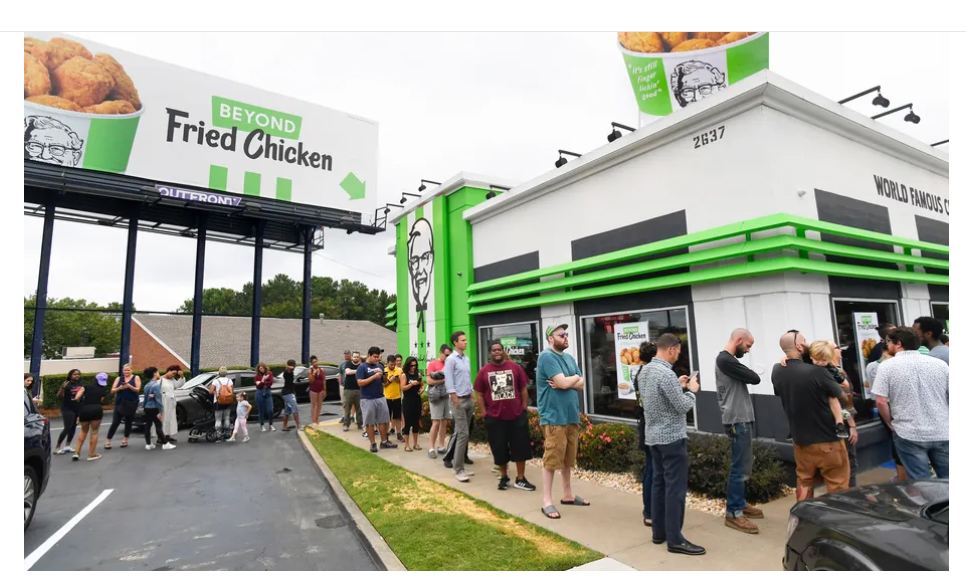
Why are these people standing in line for a bucket of soy protein isolate, yeast extract and some breadcrumbs?

Part of an ongoing series of Truth in Labeling Campaign blogs about plant-based protein substitutes.

Screenshot from Vox.com | AP Images for Beyond Meat

Last August there was a five-hour feeding frenzy at an Atlanta Kentucky Fried Chicken location.

The restaurant, decked out in special green paint to match the new colored KFC buckets, had a parade of customers that went around the building. They all were lining up for the new offering, a “plant-based” concoction made by Beyond Meat dubbed “Beyond Chicken,” which sold out in a few hours.

All the hype, news stories, and press releases (the CEO of Beyond Meat said his “only regret is not being able to see the legendary Colonel himself enjoy this important moment”) becomes even more ridiculous when you realize what these folks were waiting to purchase – a brew of brain-damaging chemicals constructed to look like a chicken nugget.

Now, this mixture of soy protein isolate, natural flavors, yeast extract and pea extract (all sources of manufactured free glutamate, or MfG) will be rolling out at 4,000 KFC locations around the U.S.

The entire concept of these so-called “plant-based meats” are the ultimate in deceiving the public. They are certainly not health foods, they won’t turn meat-eating consumers into vegans, and for those who already shun animal products this new KFC fake fare isn’t even prepared in a vegan or vegetarian manner, being cooked in the same oil as the actual KFC chicken is.

So, what’s the attraction?

As we said in a blog at the end of December, sales of these “substitute” foods (what the FDA calls them) have taken a nosedive. Despite scores of fake meat, chicken and even fish products easily available in both supermarkets and restaurants, sales have gone flat. It appears that consumers are catching on to this con. And for those still in the dark about what these foods are made from, the novelty of tasting something fake that’s pretending to be something real has worn thin.

Could it be that the only thing keeping this phony food market seemingly afloat is the sheer amount of press being given to it? The new KFC mock chicken was mentioned in practically every news source you can think of, including vegan and vegetarian publications. The ones we saw applauded it, some giving three cheers to all the chickens that will be saved by KFC (which certainly remains to be seen).

What you won’t be hearing from the media is how food chemists have managed to make a laboratory concoction comprised of highly processed ingredients that, when tweaked enough, will manage to have a chicken-like taste. It’s not easy to do. Perhaps that’s the “Kentucky Fried Miracle” they are advertising.

Here’s a look at what this faux foul is made from. The ingredients in red are all sources of MfG, the very same excitotoxic, brain damaging, glutamic acid found in all flavor enhancers, including MSG.

Water, Enriched wheat flour (Wheat Flour, Niacin, Reduced Iron, Thiamine Mononitrate, Riboflavin, Folic Acid), Soy Protein Isolate, Expeller Pressed Canola Oil, Enriched bleached wheat flour (Bleached Wheat Flour, Niacin, Reduced Iron, Thiamine Mononitrate, Riboflavin, Folic Acid), Wheat Gluten, Natural Flavor, Yeast Extract, and less than 2 percent of: Breadcrumbs (Wheat Flour, Distilled Vinegar, Sea Salt, Leavening (Sodium Bicarbonate), Inactive Yeast, Spice Extractives), Chili Pepper, Citric Acid, Garlic Powder, Leavening (Sodium Bicarbonate, Sodium Aluminum Phosphate, Monocalcium Phosphate), Modified Wheat Starch, Onion Powder, Pea Extract, Rice Flour, Salt, Spice, Titanium Dioxide (for color). (List provided by Women’s Health magazine).

Obviously, there’s no “miracle” here, just a witches’ brew of chemically processed ingredients and flavorings.

If you’re not a TLC blog reader, here’s a quick rundown of some of the things free glutamate is associated with: Parkinson’s disease, Alzheimer’s disease, multiple sclerosis, stroke, ALS, autism, schizophrenia, depression, obsessive-compulsive disorder (OCD), epilepsy, ischemic stroke, seizures, Huntington’s disease, addiction, frontotemporal dementia, attention-deficit/hyperactivity disorder (ADHD), and autism.

For a list of ingredients that contain excitotoxic amino acids, go here, also check out our website to learn more.