
If you rig your study carefully, you won’t have to think about lying with statistics

Act l:

Studies of the safety of monosodium glutamate have a certain sameness worth considering. To begin with, they are just that: studies of the safety of monosodium glutamate wherein the option of toxicity is really not considered.

The body of evidence that demonstrates that monosodium glutamate causes brain damage and endocrine disorders is dismissed with the statement that studies of animals do not represent the human condition and the FDA doesn’t disagree. Moreover, since one can’t see brain damage with the naked eye, there would be no reason for the man on the street to suspect that the brain damage that he cannot see would be caused by monosodium glutamate. And there are no physicians or alternative medicine practitioners suggesting that diagnosed endocrine disorders might have been caused by monosodium glutamate.

Only remaining for the glutamate industry to overcome are the concerns of consumers who find that ingestion of monosodium glutamate and other glutamate-containing food additives cause adverse reactions such as migraine headache, heart irregularities, and depression, and the growing number of physicians and neuroscientists who, based on clinical practice and/or experience in the laboratory, warn that ingestion of monosodium glutamate places humans at risk. Industry’s vehicle for dealing with this has been the double-blind study, rigged to encourage industry-sponsored researchers to conclude that once again there has been a study done that has failed to find that monosodium glutamate is in any way harmful.

Ajinomoto’s organization: its structure…

In response to the first reports of brain damage and adverse reactions following ingestion of monosodium glutamate, Ajinomoto Co., Inc., possibly the world’s largest producer of free glutamic acid and monosodium glutamate (and producer of many other individual amino acids), established a nonprofit corporation to represent its interests. The International Glutamate Technical Committee (IGTC) was organized in 1969 as an association of member companies engaged in manufacture, sale, and commercial use of glutamates. They sponsor, gather, and disseminate research on the use and safety of monosodium glutamate; design and implement research protocols and provide financial assistance to researchers; promote acceptance of monosodium glutamate as a food ingredient; and represent members’ collective interests. Those collective interests are to sell monosodium glutamate. The IGTC is an association of individuals, companies, and staff, composed of physicians and/or scientists employed by producers or users of glutamic acid and its salts or doing research on it in university laboratories (1).

Ajinomoto’s research strategies…

The premise that monosodium glutamate is safe for human consumption is based on human research essentially underwritten, designed, and implemented by the IGTC. Researchers have:

1) Selected subjects who might not be sensitive to the product;

2) Reduced the likelihood that subjects would react to monosodium glutamate test material;

3) Used toxic or allergenic material in placebos;

4) Used too few subjects, so there would be inadequate statistical power to produce a significant difference between adverse reactions of test subjects and placebo subjects, or to find a significant relationship between the experimental variable and the measured outcome;

5) Applied statistical tests to research designs that do not meet the tests’ underlying assumptions;

6) Focused on non-relevant variables;

7) Ignored relevant data.

Reviewed individually, inappropriate handling of subjects, methodology, and/or statistical analysis in any one study might be attributed to shoddy science or sloppy scholarship. However, there is sameness in these studies which lies in the fact that methodology virtually guarantees that no statistically significant difference between subjects treated with monosodium glutamate and subjects treated another way will be found; and/or no significant relationship will be found between two or more variables being investigated. Researchers, then, can “legitimately” conclude that subjects who were given monosodium glutamate did not have more reactions than subjects given a placebo, or subjects consuming greater quantities of monosodium glutamate did not become taller, shorter, fatter, or thinner, and did not have more adverse reactions or higher blood pressure than others. It is these studies that industry points to when claiming that monosodium glutamate is safe, or when claiming that the safety (never toxicity) of monosodium glutamate is controversial. We submit, however, that since industry bases its claim for the safety of monosodium glutamate on these studies, industry itself has demonstrated that ingestion of monosodium glutamate places consumers at risk. There really is no controversy.

Reference

  1. Samuels A. The toxicity/safety of processed free glutamic acid (MSG): a study in suppression of information. Account Res. 1999;6:259-310.

If you have questions or comments, we’d love to hear from you. If you have hints for others on how to avoid exposure to MfG, send them along, too, and we’ll put them up on Facebook. Or you can reach us at questionsaboutmsg@gmail.com and follow us on Twitter @truthlabeling.

Alzheimer’s triggered by MSG? Author and MSG-survivor Adrienne Samuels, Ph.D. traces the link

Is there a connection between MSG and Alzheimer’s? Author and MSG survivor Adrienne Samuels, Ph.D. traces the link in the study “Dose dependent toxicity of glutamic acid: A review.”

While a little bit of MSG may not obviously hurt you, remember, you can’t see the brain damage caused by eating MSG or the 40+ other food ingredients that contain MSG’s brain-damaging manufactured free glutamic acid (MfG). You won’t read about this in the New York Times or hear it from the FDA because the glutamate industry wouldn’t allow that, but you can read the open access study published online by the International Journal of Food Properties . (Clicking on the green PDF button at the journal page will make it easier to read.) And if the glutamate industry manages to have it taken down, we’ll put it back up.

It’s a simple story. L-glutamate in food, which is essential to normal body function and is the major neurotransmitter in humans, becomes excitotoxic – brain damaging — when present outside of whole protein, in excess of what a healthy human can accommodate. Put another way, if a protein is broken into individual amino acids before it is ingested, those free amino acids take on a toxic potential that they wouldn’t have if consumed in unprocessed, unadulterated protein.

As far as the excess of these free amino acids goes, there is quite enough MfG readily available in processed and ultra-processed foods, snacks and drinks to prove excitotoxic.

The fact of MSG-induced toxicity has been revisited in “Dose dependent toxicity of glutamic acid: A review.” This study also confirms the fact that excitotoxins such as MSG ingested by a mother will pass to the fetus across the placenta and be passed to the newborn through mothers’ milk.

The take-away is that food additives containing MfG, such as MSG, on one hand clearly cause human brain damage, and on the other may very well contribute to the myriad of abnormalities now recognized as being associated with glutamate, including: Alzheimer’s disease, Parkinson’s disease, multiple sclerosis, stroke, ALS, autism, schizophrenia, depression, obsessive-compulsive disorder (OCD), epilepsy, ischemic stroke, seizures, Huntington’s disease, addiction, attention-deficit/hyperactivity disorder (ADHD), frontotemporal dementia, headaches, asthma, diabetes, muscle pain, atrial fibrillation, ischemia, trauma and autism.

MSG does more than cause migraine headache and Chinese Restaurant Syndrome. MSG destroys brain cells.

Click here to read this eye-opening study.

If you have questions or comments, we’d love to hear from you. If you have hints for others on how to avoid exposure to MfG, send them along, too, and we’ll put them up on Facebook. Or you can reach us at questionsaboutmsg@gmail.com and follow us on Twitter @truthlabeling.
MSG, the secret ingredient that makes a pet food a ‘success’

For most pet owners, the proof of quality, flavorful pet food products is in watching our furry friends enjoy their food. When a new diet is introduced to a pet and it stimulates active consumption, it’s considered palatable, and therefore a success. — Kemin Industries

Your idea of a successful food for your pet is probably one that will nourish your pup or kitty and help them live a long, healthy life. But for pet food companies, success is measured by how quickly a dog or cat eagerly eats up every last bite of the same food every single day.

Palatability is a key phrase in the industry. And to ensure that the food is palatable, or tasty and appetizing to the pet, a “secret” ingredient is added — one called a “palatant.”

Palatants are big business. These additives coerce an animal into consuming what’s placed in front of it (even if it’s an unappetizing-looking bowl of hard, brown pellets) using exactly the same method that makes Cheetos irresistible or gets Doritos to taste like the most delicious thing you’ve ever put in your mouth. You know the secret ingredient as monosodium glutamate (MSG), but it’s really the manufactured free glutamate (MfG) in the MSG that triggers our taste buds and our animals’ taste buds, making them beg for more. MfG can be found in 40+ food ingredients.

Palatants, which are also called “digests,” are primarily made from either hydrolyzed animal or vegetable proteins, which invariably contain MfG. When a protein is hydrolyzed it will always create excitotoxic – brain damaging — amino acids. It doesn’t matter if that hydrolyzed protein is put in dog food or a can of tuna you eat for lunch, it will contain MfG, the brain-damaging ingredient found in MSG.

Now, if you plan is to carefully examine the labels of pet foods for this noxious ingredient, you won’t come away with much information. Palatants can be listed on the label as “natural flavoring,” “digest,” or simply incorporated into some other benign-sounding component of the food – both in bargain brands and pricy boutique ones.

There are, however, some pet foods that will tell you right on the package that they’re using MfG-containing hydrolyzed proteins.

The pea-protein gravy train

Currently, the biggest darling of the food industry is widespread, multi-purpose pea protein. It’s a cheap ingredient used to bump up protein content in scores of bars, drinks, powders for smoothies and fake foods. Read more about it here.

When used in pet food, it’s advertised as an easily digestible source of protein, and is typically found in allergy, grain-free and limited protein diets.

Purina is one of many major pet food manufacturers that uses pea protein in its dog food formulas. While consumers are starting to realize that pea protein in human foods contains excitotoxic, brain-damaging MfG, it appears that same level of concern doesn’t apply to what we feed our pets. That is, until we learn that something has gone terribly wrong.

The mysterious heart ailment associated with grain-free pet foods

In 2018 the FDA issued an alert about grain-free pet food being implicated in untold numbers of otherwise healthy dogs and cats developing dilated cardiomyopathy, a disease of the heart muscle that can come on slowly and ultimately be fatal.

In typical FDA slow-motion style, the agency first received reports of the potential connection back in 2014, yet waited four years to warn pet owners. Now we know that all breeds, ages and sizes of dogs have been involved in the 560 accounts the FDA received (which most certainly are only a fraction of the actual number of cases).

Interestingly, no heavy metal compounds were found in the foods tested, but over 90 percent of the food consisted of grain-free formulas containing pea and/or lentil protein, i.e., MfG.

Could the excitotoxic amino acids in those ingredients have triggered this deadly heart condition? It’s pretty much a given that we will never learn more from the FDA. To even consider these highly processed, toxic vegetable proteins as a potential cause of this tragedy is something that agency will never, ever do.

The U.S. pet food industry is predicted to reach $30 billion in the next two years, with more and more expensive, highly advertised and “gourmet” brands on the market. Despite all the glowing package claims and pictures of fish, meat and poultry, the contents generally consist of low-quality, toxic ingredients.

And sadly, our dogs and cats are becoming overweight, morbidly obese, diabetic and sick at an ever-increasing rate – just as are their human companions.

If you have questions or comments, we’d love to hear from you. If you have hints for others on how to avoid exposure to MfG, send them along, too, and we’ll put them up on Facebook. Or you can reach us at questionsaboutmsg@gmail.com and follow us on Twitter @truthlabeling.

Parkinson’s, Alzheimer’s, ALS, MS, epilepsy and 10+ other diseases all have this in common

It looks like Ajinomoto is fighting tooth and nail, pulling out all the stops to convince the public that their brain damaging (excitotoxic) monosodium glutamate (MSG) is harmless. They’re pouring millions of dollars into buying advertising space in newspapers throughout the world, issuing press releases, covertly publishing YouTube commercials dressed up as news, buying testimonials from celebrity chef, sports personalities, and good-looking young women who call themselves “sci moms.” They’ve mastered brainwashing on social media. Yet people keep getting sick after eating MSG. Not everyone, of course, just lots of people. And Ajinomoto’s MSG sales have been slipping.

There’s something else, too. Scientists are beginning to realize that somehow glutamate has something to do with increases in Parkinson’s disease, Alzheimer’s disease, multiple sclerosis, stroke, ALS, autism, schizophrenia, depression, obsessive-compulsive disorder (OCD), epilepsy, ischemic stroke, seizures, Huntington’s disease, addiction, attention-deficit/hyperactivity disorder (ADHD), frontotemporal dementia, and autism. No one has yet identified a cause and effect relationship, but the scientific community now recognizes that glutamate is associated with each of them. Data? A January 18, 2020 Medine search (www.pubmed.gov) for “glutamate-induced,” returned 3742 references.

If you have questions or comments, we’d love to hear from you. If you have hints for others on how to avoid exposure to MfG, send them along, too, and we’ll put them up on Facebook. Or you can reach us at questionsaboutmsg@gmail.com and follow us on Twitter @truthlabeling.

MSG is great for masking rancid flavors in forgotten food

If you’re not opposed to a little brain damage caused by excitotoxins like MSG, hydrolyzed protein products and autolyzed yeast extract, and you don’t suffer any of the side effects of manufactured free glutamate (MfG) like migraine headache, irritable bowel, atrial fibrillation, and seizures, you might be tempted to use MSG or one of its analogs to mask the rancid flavors of food you’ve left in the fridge too long.

While historically the Chinese have sprinkled a little MSG on their fresh-picked grains and vegetables to give them an exaggerated taste, today MSG is being used in the United States primarily to give flavor to food of inferior quality and poor nutritive value, and to provide flavor to the chemicals that are used liberally in ultra-processed foods.  MSG is also used to mask rancidity.

If you have questions or comments, we’d love to hear from you. If you have hints for others on how to avoid exposure to MfG, send them along, too, and we’ll put them up on Facebook. Or you can reach us at questionsaboutmsg@gmail.com and follow us on Twitter @truthlabeling.
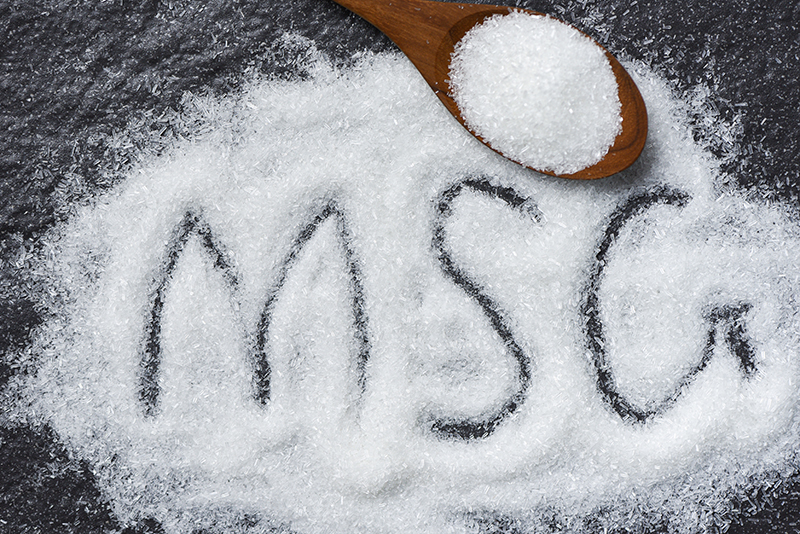
Plant-based meat replacers promote obesity, infertility and migraine headache

Until fairly recently, the thing called “food” used to be food, not manufactured amino acids and other chemicals.

Then, someone discovered that a huge, virtually untapped goldmine was out there for things that could be advertised as protein-containing meat-like “foods” that weren’t made from animals. That market is now reported to be hitting $4.5 billion in yearly sales and expected to grow substantially every year.

These protein substitutes have now become so popular that the Impossible Burger from Impossible Foods and the Beyond Burger from Beyond Meat have made the jump not just into supermarket meat aisles, but to fast-food places like Burger King and Dunkin’ Donuts.

But there’s a problem. This mock meat contains excitotoxic (brain damaging) manufactured free glutamic acid (MfG) — the same toxic ingredient found in monosodium glutamate.

Don’t expect to find that information on the label. And especially don’t expect the fake-food industry to tell you that glutamic acid is associated with Parkinson’s disease, Alzheimer’s disease, multiple sclerosis, stroke, ALS, autism, schizophrenia, depression, obsessive-compulsive disorder (OCD), epilepsy, ischemic stroke, seizures, Huntington’s disease, addiction, frontotemporal dementia, attention-deficit/hyperactivity disorder (ADHD), and autism.

There’s protein in meat, fish and poultry. But what’s made in food-processing plants and marketed as a replacement for meat isn’t protein. Although those products contain amino acids with names like the ones that are found in meat, fish, and poultry, don’t be fooled. The amino acids in these imposters have been manufactured in food- processing and/or chemical plants, and all come loaded with unwanted by-products of production (a.k.a. impurities) such as D-glutamic acid and pyroglutamic acid, three of those amino acids being excitotoxins – meaning they kill brain cells.

The names of some of the ingredients that contain excitotoxic amino acids may be familiar to you. They include monosodium glutamate (MSG), maltodextrin, hydrolyzed mung beans and other hydrolyzed protein products, pea protein isolate and other protein isolates and concentrates, all of which contain excitotoxic MfG. (More are listed here.)

You can find additional information on the webpage and blogs of The Truth in Labeling Campaign.

If you have questions or comments, we’d love to hear from you. If you have hints for others on how to avoid exposure to MfG, send them along, too, and we’ll put them up on Facebook. Or you can reach us at questionsaboutmsg@gmail.com and follow us on Twitter @truthlabeling.

Want to know if there is free glutamic acid in a processed food? Try asking!

There’s an old adage that says, “the proof of the pudding is in the eating,” but if you think the pudding you’re about to eat might have MSG in it, better have it tested before you indulge.

You don’t have to have it tested yourself, however, you can ask the company for an assay for free amino acids. Every manufacturer must have one.

The manufactured free amino acid — called glutamic acid — is what becomes excitotoxic, killing brain cells when ingested in amounts greater than what the body needs for normal function. That same glutamic acid causes reactions which include asthma, a-fib, tachycardia, irritable bowel, migraine headache, and seizures. (If they admit to MSG causing any reactions, members of the glutamate industry talk about something called “Chinese Restaurant Syndrome,” which doesn’t include any of the above or 100 or so other reactions).

Remember to ask for an assay for free amino acids. Glutamic acid bound with other amino acids in protein does not cause either brain damage or reactions.

If you have questions or comments, we’d love to hear from you. If you have hints for others on how to avoid exposure to MfG, send them along, too, and we’ll put them up on Facebook. Or you can reach us at questionsaboutmsg@gmail.com and follow us on Twitter @truthlabeling.

$cience for sale

If you’ve seen one creative combination of brain-washing and out-and-out lies, you’ve seen them all.

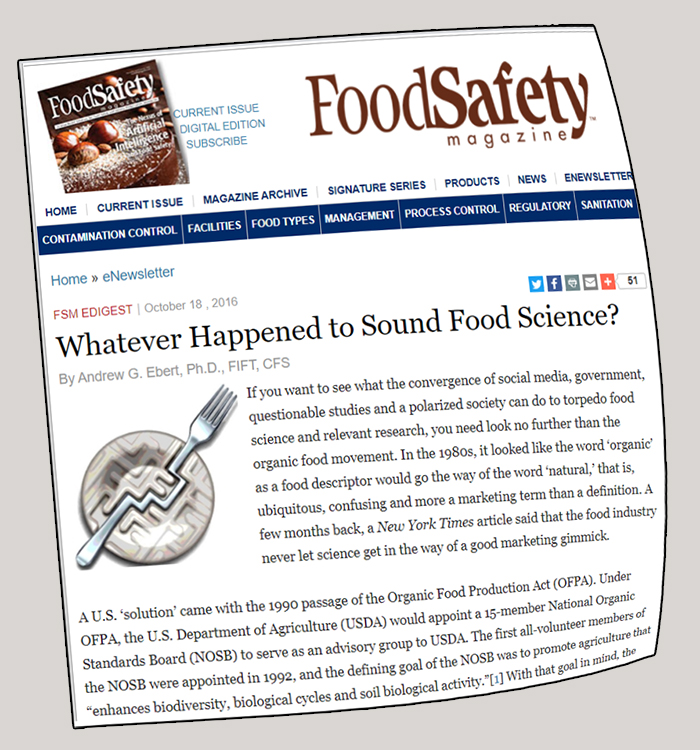
But this article that appeared in Food Safety Magazine is special. Special because Andrew G. Ebert signed his name to it. To appreciate why “Whatever Happened to Sound Food Science” is so special – so poetic — you have to know that Andrew G. Ebert was Ajinomoto’s “scientist” in the United States rigging studies of the safety of MSG so that his researchers could claim “once more” they had been unable to find anything that suggested MSG was toxic.

You can read all about Big Food’s friend “Andy Ebert” on our webpage. We call him “The Architect of it All” because he did just about everything for Ajinomoto short of manufacturing the MSG. He not only designed the rigged research for them, but put together a committee of esteemed “scientists” who walked his protocols over to the offices of the FDA and had them approved by the agency before the studies were published. Ebert faded from sight, and there were no more double-blind studies after Jack Samuels, co-founder of the Truth in Labeling Campaign, ratted on him. That’s how the Glutes do it. No apology. Not even discussion. Just ignore the evil things you’ve done and hope that no one will remember.

Read Ebert’s bio and note three things:

Andrew G. Ebert, Ph.D., FIFT, CFS, is a noted food industry pharmacologist and toxicologist. He has served as an official observer at numerous meetings of the Food and Agriculture Organization/World Health Organization Codex Alimentarius Food Standards Programme and is on the Expert Committee on Food Ingredients of the Food Chemicals Codex. He previously served on FDA’s Food Advisory Committee.

First, Ebert is everywhere, a man of good reputation, serving on committees of organizations like the World Health Organization (and testifying to the fact that MSG is “safe”); he has served on the FDA’s Food Advisory Committees (in a position reserved for consumers); and nowhere does it mention the fact that for years he was chairman of Ajinomoto’s International Glutamate Technical Committee, running their U.S. research arm while Richard Cristol ran their merchandising/propaganda campaigns.

If you have questions or comments, we’d love to hear from you. If you have hints for others on how to avoid exposure to MfG, send them along, too, and we’ll put them up on Facebook. Or you can reach us at questionsaboutmsg@gmail.com and follow us on Twitter @truthlabeling.
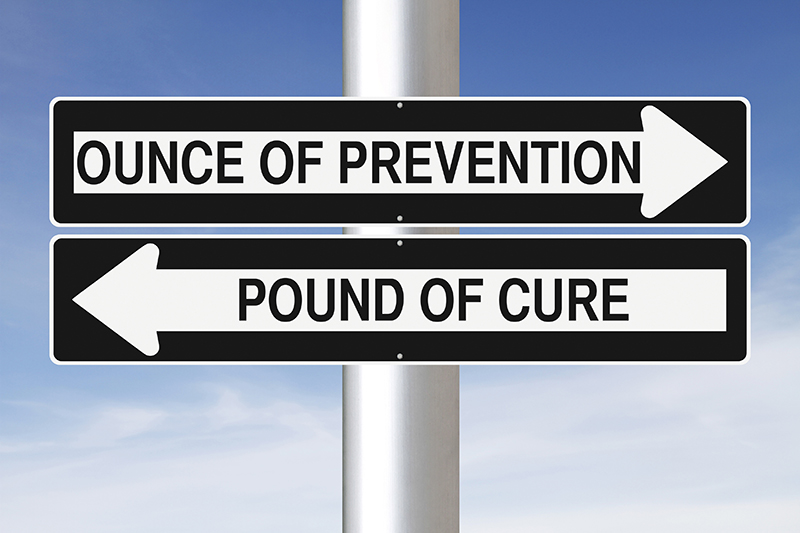
An ounce of prevention, worth even more when you know of no cure

If you were to read the medical literature, you’d find that high levels of glutamic acid in the body (a.k.a. glutamate) are associated with Parkinson’s disease, Alzheimer’s disease, multiple sclerosis, stroke, ALS, autism, schizophrenia, depression, obsessive-compulsive disorder (OCD), epilepsy, ischemic stroke, seizures, Huntington’s disease, addiction, attention-deficit/hyperactivity disorder (ADHD), frontotemporal dementia, autism and more.

Of course, those who manufacture and sell Manufactured free Glutamate (MfG) claim it’s harmless. And to back up those claims they rig their “scientific” studies and pay millions to PR firms to spread their propaganda.

Propaganda: more powerful than research
How the ‘MSG safe’ game is played
Recipe for deception
Propaganda 101
Is this propaganda hiding in the business section of your newspaper?
‘Sometimes, you just have to stand up there and lie’
Writers engaged in spreading the Glutes’ propaganda and the outlets that enable them
Another MSG YouTube propaganda video

Don’t be a victim. Don’t make your children victims. Avoid the hidden sources of excitotoxic MfG along with excitotoxic aspartic acid (found in aspartame and aliases) and excitotoxic L-cysteine (found in dough conditioners). Yes, you really can avoid them when you know what to look for.

If you have questions or comments, we’d love to hear from you. If you have hints for others on how to avoid exposure to MfG, send them along, too, and we’ll put them up on Facebook. Or you can reach us at questionsaboutmsg@gmail.com and follow us on Twitter @truthlabeling.