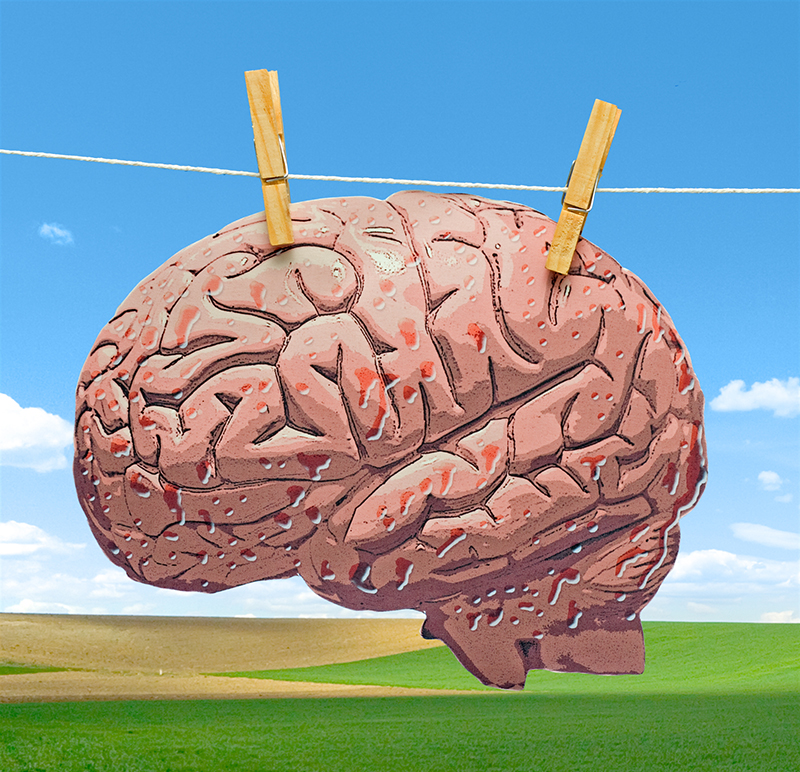
If you’ve seen one creative combination of brain-washing and out-and-out lies, you’ve seen them all.
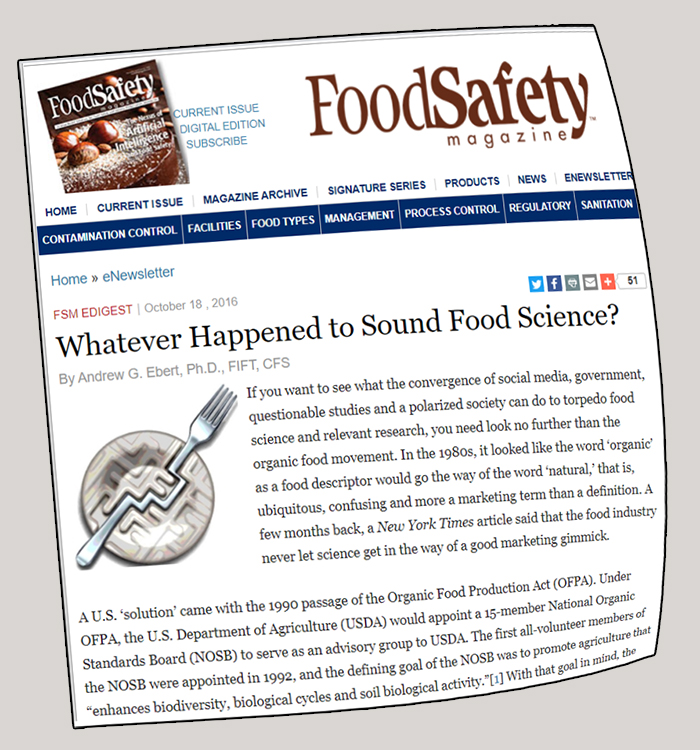
But this article that appeared in Food Safety Magazine is special. Special because Andrew G. Ebert signed his name to it. To appreciate why “Whatever Happened to Sound Food Science” is so special – so poetic — you have to know that Andrew G. Ebert was Ajinomoto’s “scientist” in the United States rigging studies of the safety of MSG so that his researchers could claim “once more” they had been unable to find anything that suggested MSG was toxic.
You can read all about Big Food’s friend “Andy Ebert” on our webpage. We call him “The Architect of it All” because he did just about everything for Ajinomoto short of manufacturing the MSG. He not only designed the rigged research for them, but put together a committee of esteemed “scientists” who walked his protocols over to the offices of the FDA and had them approved by the agency before the studies were published. Ebert faded from sight, and there were no more double-blind studies after Jack Samuels, co-founder of the Truth in Labeling Campaign, ratted on him. That’s how the Glutes do it. No apology. Not even discussion. Just ignore the evil things you’ve done and hope that no one will remember.
Read Ebert’s bio and note three things:
Andrew G. Ebert, Ph.D., FIFT, CFS, is a noted food industry pharmacologist and toxicologist. He has served as an official observer at numerous meetings of the Food and Agriculture Organization/World Health Organization Codex Alimentarius Food Standards Programme and is on the Expert Committee on Food Ingredients of the Food Chemicals Codex. He previously served on FDA’s Food Advisory Committee.
First, Ebert is everywhere, a man of good reputation, serving on committees of organizations like the World Health Organization (and testifying to the fact that MSG is “safe”); he has served on the FDA’s Food Advisory Committees (in a position reserved for consumers); and nowhere does it mention the fact that for years he was chairman of Ajinomoto’s International Glutamate Technical Committee, running their U.S. research arm while Richard Cristol ran their merchandising/propaganda campaigns.
If you have questions or comments, we’d love to hear from you. If you have hints for others on how to avoid exposure to MfG, send them along, too, and we’ll put them up on Facebook. Or you can reach us at questionsaboutmsg@gmail.com and follow us on Twitter @truthlabeling.
How our perceptions of what’s safe to eat are swayed by the PR industry Guest blog by Linda Bonvie
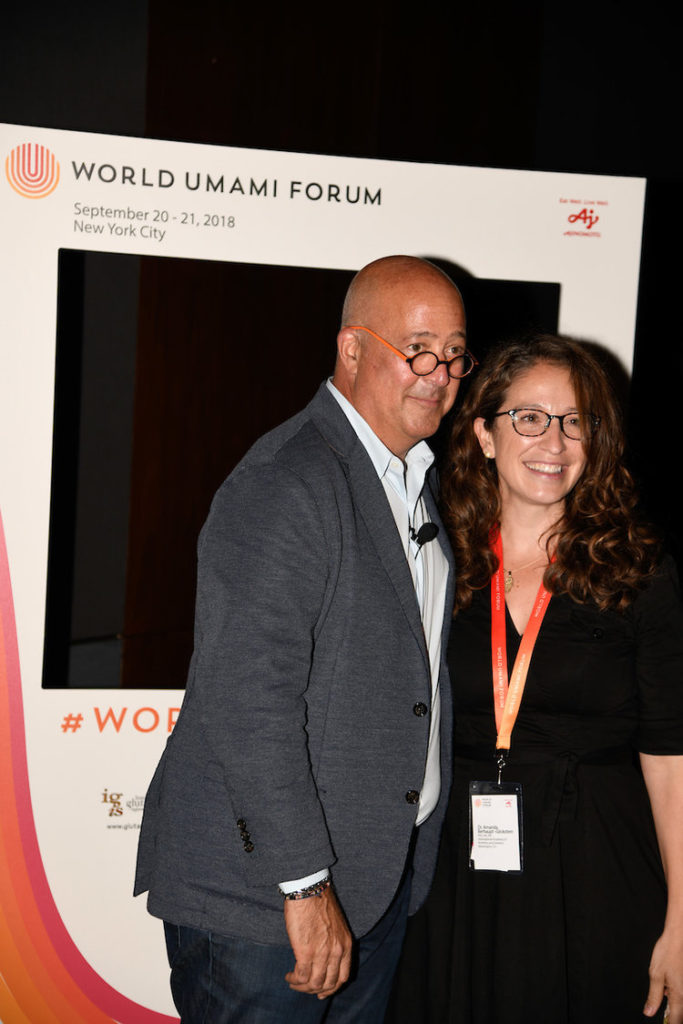
For two days in September 2018, the Conrad Hotel in New York City hosted an invitation-only shindig where large quantities of wine flowed, lunch and dinner were served, chefs whipped up dishes in cooking presentations and experts gave talks and demonstrations — all extensively photographed and videotaped. Leading the event was the Travel Channel’s “Bizarre Foods” celeb chef, Andrew Zimmern, who posed with guests for untold numbers of photos wearing his trademark round spectacles perched low on his nose.
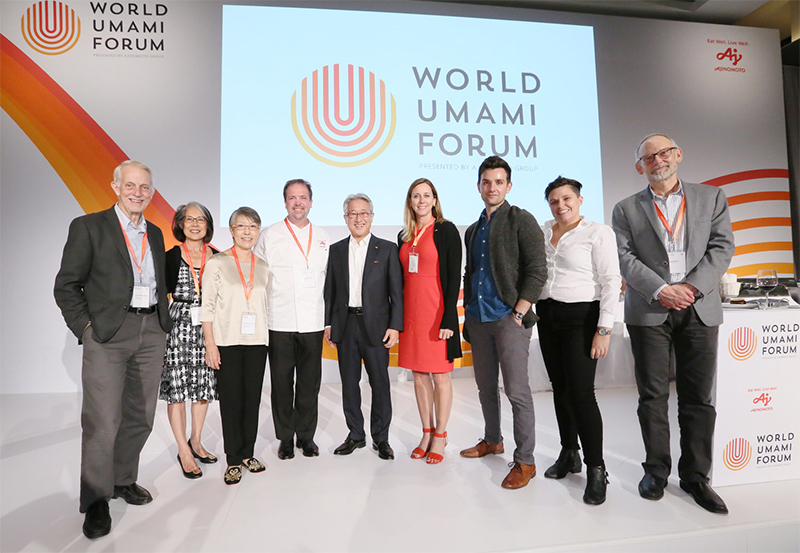
If you took a casual look at the goings-on, it might appear to have been any other well-planned, fancy corporate convention. But it wasn’t. This was more of a boot camp for journalists and bloggers to help them effectively spread the messaging of Ajinomoto, the world’s largest producer of monosodium glutamate.
Dubbed the “World Umami Forum,” the affair took place at the mid-point in a ten-million dollar campaign spearheaded by PR giant Edelman Public Relations. Among the goals of Edelman’s client Ajinomoto is to have the press (and eventually, they hope, everyone else) start replacing the tainted name of MSG with the more pleasing umami.
From left, Gary Beauchamp, PhD, Mary Lee Chin, MS, RD, Dr. Kumiko Ninomiya, Executive Fellow Ajinomoto, Chef Chris Koetke, Takaaki Nishii, CEO and President Ajinomoto, Tia M. Rains, public relations director Ajinomoto, Ali Bouzari, Sarah Lohman, Harold McGee.
Public relations blitzes, of course, are nothing new. There were plenty of tricky PR tactics spun for the benefit of Big Tobacco. Edelman, in fact, was behind such a campaign, as detailed in the tobacco industry cache of papers uncovered during decades of litigation. Its 1978 document called “Taking the initiative on the smoking issue – a total program,” designed for RJ Reynolds, outlines several ways that “another point of view on the cigarette question” could be promoted. One plan was the creation of a “National Smokers’ News Bureau” in New York, which would “set up interviews, organize editorial briefings…and engage in extensive personal contact with media to develop specific storylines.”
What makes a modern-day Edelman storyline travel much further than those in the past, however, is reflected by the sheer number of outlets to which they’re deployed, along with a media that seems more ready, willing and able to cooperate than ever before.
Dishing out disinformation over dinner and drinks
Celeb chef Andrew Zimmern and World Umami Forum guest. (Photo Loren Wohl/AP Images)
The articles and blogs that were published as a result of the umami gathering all had an amazingly similar ring to them. Authors always seemed to drop in a mention of “Chinese restaurant syndrome,” referring to a letter sent to the New England Journal of Medicine back in 1968 as the main reason why MSG got a bad rap in the U.S. (one of Edelman/Ajinomoto’s most oft repeated, fabricated storylines).
Some of the pieces were done more creatively than others, but all managed to drive home specific key points emphasized at the umami event, dutifully repeated by writers of all stripes. But no doubt it was the headlines that made the Edelman folks smug with the satisfaction of a job well done – most especially the one that ran in the Wall Street Journal.
The story, by WSJ writer River Davis, originally appeared in the April 27, 2019 print edition of the paper under the headline “Rescuing MSG’s Unsavory Reputation” — one quickly changed online to read, “The FDA Says It’s Safe, So Feel Free to Say ‘Yes’ to MSG.”
Even the subhead was altered, adding the word “healthy” in for good measure.
Realize for a moment that here we have a top-tier newspaper switching a headline and subhead so it contains a positive string of word parings (safe, healthy, MSG, yes), and ending with a long-used PR/marketing tactic known as a call to action. That’s when the consumer is instructed to do something that will help sales, e.g., “ask your doctor,” “click here,” “call now,” or in this case, “say yes.”
Why would the WSJ do that? I attempted to find out.
Asking the question in an email to Colleen Schwartz, a communications executive at Dow Jones, I continued to poke around online, soon finding a string of shared MSG stories at the Linkedin page of Edelman SVP of Food & Beverage Gennifer Horowitz. She had posted several of the articles published after the umami forum, most to rave reviews from colleagues. But what caught my eye was the WSJ one with the “yes” headline, commented on by a Linkedin connection of Horowitz (who previously worked with the Andrew Zimmern “brand”): “What a huge win for Ajinomoto and MSG! Congrats to the whole team!”
Hmm, what could this huge win be? Might the comment be referring to the headline swap?
I took that question directly to Schwartz, asking if the change was made at the behest of Edelman Public Relations. Schwartz emailed back almost immediately, saying she would have a response for me the next day. When the next day rolled around, she said that she needed more time, as she was “coordinating with colleagues in APAC.”
The statement she finally came back to me with was simply: “Wall Street Journal articles regularly run with different headlines in print and digital due to independent editorial preferences and space constraints. In this case, the difference in headlines is noted in the tag online: ‘Appeared in the April 27, 2019, print edition as ‘Rescuing MSG’s Unsavory Reputation.’”
Asking further questions of Schwartz proved useless. “Our statement stands – I won’t have any further comment for you,” she wrote back.
Too close for comfort
For the casual reader to know the difference between true news reporting or a writer simply giving coverage to a PR firm’s storyline isn’t easy. In the case of Edelman, its connection to the WSJ is a long and established one, even where its employees are concerned.
For example, it’s no secret that Edelman NYC brand director Nancy Jeffrey spent 10 years as a WSJ writer. Nor is Edelman’s warm and fuzzy relationship with the paper hush-hush.
As quoted in an Edelman website blog, Jeffrey recalls how Richard Edelman (son of founder Dan) would call her during her time at the paper “to meet with a client with a story to tell.” The “Edelman ethos,” Jeffrey says, is that “no one at Edelman ever rises too high to pitch a reporter.”
As for headlines, getting your messaging above the actual story may even outperform whatever the article says.
In a New Yorker story titled How headlines change the way we think, writer Maria Konnikova tells about an Australian study that found a reader’s take-away from an article is, in fact, dictated by the headline.
“By its choice of phrasing,” she writes, “a headline can influence your mindset as you read so that you later recall details that coincide with what you were expecting.”
Utilizing that concept in the digital media age can warp your mindset even more. An article that appeared in the online publication Vox a few months after the umami affair, although headlined “But what does umami taste like?” contained a snippet of code in the page so that when it’s shared online, the headline is replaced with “MSG is the purest form of umami…,” a line also used in an Ajinomoto MSG “fact sheet” and by the Glutamate Association.
Owned media, or a media owned?
Richard Edelman during an interview at the USC Annenberg School for Communication and Journalism.
Mainstream media, said Edelman president and CEO Richard Edelman during an interview recently at the USC Annenberg School for Communication and Journalism, is on its way out. He calls the “notion” that media will continue on as we know them today “fallacious.” And what will replace them? According to Edelman, that will be “owned media,” meaning outlets – whether they be websites, blogs or even Facebook or Twitter accounts – over which businesses have complete control of content.
As newsrooms shrink, he says, companies are realizing “they have to tell their own stories.”
But considering how firms such as Edelman can enable companies that can afford a big PR tab to tell their own story anyway, will that really make much of a difference?
If Edelman has a catchphrase, it would probably be the Edelman Master Narrative, a.k.a. “the most important story you have to tell.”
Of course, when your client is Ajinomoto, that “story” will never include mention of the fact that MSG – a totally manufactured additive – is “excitotoxic,” meaning it can cause brain damage. It won’t disclose how MSG can trigger lifelong adverse reactions in an unborn child when a pregnant woman consumes food that contains the additive. Or that MSG, which always comes along with impurities in the finished product, is not identical to the glutamate in the human body and does not occur naturally in unprocessed foods. You won’t hear that MSG can cause a long list of adverse events (at levels that vary considerably from person to person), which can affect organs from the brain, to the heart, to the lungs to the bowels.
Do the folks at Edelman know this? Perhaps.
As reported in Gawker a decade ago, an unnamed PR executive “tipster” told how at an Edelman upper-management training session, attendees were told: “Sometimes you just have to stand up there and lie. Make the audience or the reporter believe that everything is OK.”
Contrary to what you’ll hear from industry (which includes the majority of Internet and news stories as well as YouTube videos), monosodium glutamate (a.k.a. MSG) isn’t made from natural products like sugar cane and tapioca, corn starch, sugar beets or molasses. That’s not how Ajinomoto – the world’s largest producer of MSG – has been making it in the U.S. since 1957. For over 60 years MSG has been produced using carefully selected genetically modified bacteria that excrete glutamic acid through their cell walls.
And, contrary to Glute propaganda, that’s not how wine, beer, vinegar and yogurt are made.
Glutamic acid (a.k.a. glutamate) is the active ingredient in MSG. It’s glutamate that triggers glutamate receptors in the mouth and on the tongue, causing them to swell, so to speak, giving the food with which the MSG is ingested a bigger, more robust, taste, than it would have without it.
There’s nothing natural about MSG. It’s manufactured.
If you have questions or comments, we’d love to hear from you. If you have hints for others on how to avoid exposure to MfG, send them along, too, and we’ll put them up on Facebook. Or you can reach us at questionsaboutmsg@gmail.com and follow us on Twitter @truthlabeling.
Ajinomoto began its challenge to MSG toxicity in 1968, following the revelation that MSG killed brain cells in laboratory animals.
Contrary to the myths circulated by the Glutes, the first hint that MSG might be toxic came from studies of the retina done by Lucas and Newhouse back in 1957. That was followed by a study titled “Brain lesions, obesity, and other disturbances in mice treated with monosodium glutamate” done by Olney and published in 1969 after having been shared with Ajinomoto in 1968.
The take-away from that research would have been that MSG causes brain damage and, possibly independently, also damages the retina.
Ajinomoto began its challenge to MSG toxicity in 1968 after learning of Olney’s work, by pretending to replicate Olney’s studies. They set up studies that couldn’t possibly demonstrate brain damage. Not by falsifying data, because that would have been deemed fraudulent. Instead, they rigged their studies by using methodology that would guarantee their results would come out as desired – techniques that would make it impossible to conclude “with certainty” that MSG caused brain damage.
As time went on and reports of reactions to MSG increased, Ajinomoto moved to human double-blind studies that were also rigged to guarantee that researchers could claim to find no evidence of MSG toxicity. In those studies, as many people would react to placebos as reacted to MSG because the placebos contained an excitotoxin (the aspartic acid in aspartame) that was so similar to the excitotoxic glutamic acid in MSG that it would cause the exact same reactions as would be caused by MSG.
When the Glutes talk about MSG getting a bad rap, they don’t talk about brain damage or retinal degeneration, both of which are caused by ingestion of MSG. They don’t mention MSG-induced obesity or infertility, also caused by MSG. And they’re not very specific about MSG-reactions like migraine headache either. Our research suggests that this “bad rap” they’re so fond of talking about is just another attempt to hide the truth about toxic MSG and clean up MSG’s bad name.
Out of curiosity we searched for examples of “bad raps” — statements made about MSG that industry claims are simply not true. But we couldn’t find any. We found only fallacious statements made by the Glutes about the safety of MSG.
Doesn’t look like MSG got a bad rap at all.
If you have questions or comments, we’d love to hear from you. If you have hints for others on how to avoid exposure to MfG, send them along, too, and we’ll put them up on Facebook. Or you can reach us at questionsaboutmsg@gmail.com and follow us on Twitter @truthlabeling.
The myth that MSG is a harmless food additive that can trigger a limited number of insignificant reactions was launched in 1968 when the New England Journal of Medicine carried a letter from Dr. Ho Man Kwok that the journal titled Chinese Restaurant Syndrome. Glutamate industry agents hyped the fact that Kwok reported minor reactions to food eaten in a Northern-Chinese restaurant. And the myth was propelled forward along an unmuddied path as the myriad of scientific studies done in the 1970s showing MSG-induced brain damage, obesity, and infertility were suppressed, and all reactions other than those mentioned in Kwok’s letter were denied.
Myth: Monosodium glutamate (MSG) is a harmless food additive. Scientific research has shown that MSG is a harmless food additive because study after study have failed to show that MSG causes adverse reactions.
Fact 1: The studies cited by the Glutes as evidence of MSG safety are studies in which MSG was fed to volunteers who were given test material containing MSG at one time, and at another time given a placebo that contained (without disclosure) an excitotoxic amino acid — one that would trigger the exact same reactions as those caused by MSG. When subjects reacted to both test material and placebo, which they did, researchers claimed to have again failed to demonstrate MSG toxicity. More on this subject can be found at https://www.truthinlabeling.org/flawed.html.
Fact 2: Studies showing MSG-induced brain damage were challenged by the Glutes in the 1970s, but the challenges were refuted. Now, MSG-induced brain damage is never mentioned by industry.
Myth: The FDA has investigated some of the claims of reactions to MSG and has never been able to confirm that the additive caused the reported effects.
Fact: By law, the FDA is required to investigate claims of serious reactions to the products they regulate, but they rarely do so. The reports of at least two FDA investigators who examined reports of serious reactions following ingestion of MSG did not reflect the data that had been given them by the persons reacting to MSG or by their physicians. More on this subject can be found at https://www.truthinlabeling.org/assets/it_wasnt_az.pdf.
Myth: The FDA commissioned a group of independent scientists from the Federation of American Societies for Experimental Biology (FASEB) to examine the safety of MSG in the 1990s, and FASEB determined that MSG is safe.
Fact: At least 3 of the alleged “independent” scientists had clear-cut conflicts of interest.
Myth: The extensive body of research which exists about glutamate has been reviewed by independent scientists and regulatory authorities around the world — all have found MSG to be safe.
Fact: The scientific authorities from around the world often cited by the Glutes, (which included the Federation of American Societies for Experimental Biology (FASEB), the United Nations World Health Organization/Food and Agriculture Organization’s Joint Expert Committee on Food Additives (JECFA), the European Communities’ (EC) Scientific Committee for Food, and the Council on Scientific Affairs of the American Medical Association) considered only those documents submitted to them by Ajinomoto’s International Glutamate Technical Committee (IGTC) or their agents, or their glutamate-industry friends at the FDA.
Myth: MSG is made from corn starch, sugar cane, sugar beets or molasses by a natural method that has been used for centuries. This is known as the fermentation process. It is similar to how wine, beer, vinegar and yogurt are made.
Fact: In 1956, the Japanese succeeded in producing glutamic acid by means of bacterial fermentation, and after considerable research to identify suitable strains of microorganisms for starting the requisite cultures, large-scale production of glutamic acid and monosodium glutamate through fermentation began. In this fermentation process, genetically modified bacteria are grown aerobically in a liquid nutrient medium. These bacteria have the ability to synthesize glutamic acid outside of their cell membranes and excrete it into the medium to accumulate there.
This is a new process, not one used over centuries. And certainly not how wine, beer, vinegar and yogurt are made.
Myth: The glutamate in unprocessed/ unadulterated/ unfermented protein is the same as the glutamate in MSG. The glutamate that naturally occurs in many foods and the glutamate added in monosodium glutamate (MSG) are exactly the same.
Fact 1: The glutamate found in unprocessed/unadulterated/unfermented protein is L-glutamate only. Whereas MSG used in cosmetics, drugs, vaccines, dietary supplements, and processed food is manufactured, and always contains L-glutamate plus D-glutamate (an unwanted byproduct of L-glutamate production) plus other unwanted by-products of production that industry calls impurities. And since industry has not found a way to remove the unwanted impurities from processed free L-glutamate, the glutamate in MSG always comes with impurities.
Fact 2: It is glutamic acid that has been manufactured that causes brain damage and adverse reactions. Glutamic acid found in unadulterated protein causes neither brain damage nor adverse reactions.
Myth: There is no difference between the toxicity of food that is high in glutamate, and processed food that contains MSG.
Fact: Food that is unprocessed, unadulterated and unfermented, no matter how much glutamate it contains will not cause adverse reactions in MSG-sensitive people. Food that contains MSG will cause MSG-reactions in MSG-sensitive people if the amounts ingested exceed individual tolerances for MSG.
Myth: Monosodium glutamate has been in use for over 2,000 years.
Fact: Monosodium glutamate was invented in 1908 and reformulated in 1957.
Myth: The reactions to monosodium glutamate are mild and transitory.
Fact: Asthma, migraine headache, depression, atrial fibrillation, tachycardia, and seizures are just a few of the abnormalities known to be triggered by MSG.
Myth: The glutamic acid in monosodium glutamate is identical to the glutamic acid in unadulterated protein.
Fact: Glutamic acid found naturally in protein is L-glutamic acid, only. Glutamic acid in MSG, i.e., processed/manufactured glutamic acid, is always made up of both L-glutamic acid and D-glutamic acid, and is always accompanied by impurities in addition to the D-glutamic acid that is invariably produced when attempts are made to produce L-glutamic acid.
Myth: No one reacts to less than 3 grams of MSG.
Fact: Published studies by Scopp and Allen and hundreds of comments by MSG-sensitive people affirm that less than 3 grams of MSG may cause reactions.
Myth: Reactions to MSG occur within 10 minutes of ingesting MSG and last for less than 2 hours.
Fact: Reactions to MSG have been known to occur as long as 48 hours after ingestion and last for days.
Myth: MSG is naturally occurring.
Fact 1: By FDA definition, arsenic and hydrochloric acid would be “naturally occurring” along with MSG. Industry gets mileage from talking about MSG being “naturally occurring.” And the FDA cooperates by refusing to define the term.
Fact 2: In the United States, MSG is manufactured in Ajinomoto’s plant in Eddyville Iowa. MSG is a product of manufacture. It doesn’t occur naturally anywhere or in anything.
Myth: The blood brain barrier protects the brain from excesses of monosodium glutamate.
Fact: The blood brain barrier, once thought to prevent glutamate from sources outside of the body from entering the brain, is not fully developed until puberty, is easily damaged by such conditions as high fever, a blow to the head, and the normal course of aging. In the area of the circumventricular organs (which includes the area of brain damaged by MSG), it is leaky at best during any stage of life.
If you have questions or comments, we’d love to hear from you. If you have hints for others on how to avoid exposure to MfG, send them along, too, and we’ll put them up on Facebook. Or you can reach us at questionsaboutmsg@gmail.com and follow us on Twitter @truthlabeling.
According to PETA, numerous food and beverage companies, including Coca-Cola and General Mills, have stopped conducting tests on animals to “establish health claims for the marketing of products.”
Ajinomoto, the world’s largest manufacturer of monosodium glutamate, is not one of them.
The group describes torturous experiments such as cutting open dogs’ stomachs to insert feeding tubes to deliver liquid diets with MSG, removing stomach fluids and injecting them with drugs.
Below is the petition by PETA (with link) asking Ajinomoto to put an end to its animal testing.
Urge MSG Flavor Giant Ajinomoto to End Horrific Tests on Dogs, Others
Japan-based conglomerate Ajinomoto Co., Inc.—the world’s largest manufacturer of the controversial food flavor enhancer monosodium glutamate (MSG) as well as the owner of packaged frozen food brands Tai Pei, Ling Ling, and José Olé—has been tormenting thousands of dogs, fish, gerbils, guinea pigs, mice, pigs, rabbits, and rats in horrific and deadly experiments since the 1950s. The company has ignored numerous attempts by PETA to discuss putting an end to worthless animal testing using its ingredients.
It’s time Ajinomoto paid attention, and we need your help.
Why Animal Testing? Food companies frequently torment and kill animals in abusive tests to make dubious human health claims about food products and ingredients in order to market them to consumers. But the truth is that these experiments aren’t required by law, nor do they have any relevance to human health.
It doesn’t have to be this way. Superior non-animal research methods, including studies safely conducted on human volunteers or donated human tissue, are readily available, more affordable than animal tests, and far more reliable.
What Is Ajinomoto Doing to Animals? Ajinomoto experimenters have cut open dogs’ stomachs and inserted tubes, starved them for 18 hours, given them liquid diets with MSG and other common amino acids, taken their stomach fluid, and injected them with drugs. They’ve also fed rabbits a common amino acid, starved them, repeatedly taken their blood, and then killed and dissected them. And Ajinomoto has funded or conducted recently published experiments in which rats or mice have endured their nerves being cut and have been starved, forced to run or swim, force-fed, injected with a variety of toxic cancer drugs, electrocuted, and cut open, causing some to die from botched surgeries while others were killed and dissected.
What’s PETA Doing to Help? PETA is leading the global effort to end abhorrent animal testing in the food and beverage industry. Major companies such as Kellogg, The Coca-Cola Company, and General Mills have adopted new policies banning animal tests following talks with PETA scientists. It’s time that Ajinomoto joined the dozens of other food and beverage companies throughout the world that, after talking with PETA, have stopped funding or conducting shocking animal tests that aren’t even required by law.
Please take action and let Ajinomoto know that it’s time it banned animal testing. (The petition you can sign is at the bottom of the page linked below). https://support.peta.org/page/14048/action/1?
Everyone wants their share of the pie. Ajinomoto gets theirs in part by selling toxic amino acids and the food ingredients/products that contain them – excitotoxic glutamic acid (glutamate) in monosodium glutamate (MSG) and excitotoxic aspartic acid (aspartate) in aspartame, equal, AminoSweet, and other sugar substitutes. Monsanto/Bayer gets theirs in part by selling Roundup, which contains toxic glyphosate. And you, the consumer, would have to work hard to avoid the products of either manufacturer.
But savvy consumers are starting to have their say with companies that purchase from Ajinomoto and Monsanto/Bayer – and that will cost Ajinomoto and Monsanto/Bayer. An article by Robert Arnason in The Western Producer tells the story of what can happen when a major company gets pushed by consumers to threaten its piece of the pie. Arnason tells us that in order to keep its customers happy and buying its product, they will find a way to eliminate toxins that customers refuse to purchase.
According to Arnason, “General Mills, like all companies, needs happy and satisfied customers. That’s why it’s asking suppliers, farmers who produce oats, wheat, sugar, soybeans and other commodities, to reduce pesticide use.
“‘We can see the trends. Consumers want less pesticide in their food,’ said John Wiebold, General Mills vice president, North American direct material sourcing. ‘They want less things in their food that shouldn’t be there.’
“The company … intends to reduce pesticide use in its supply chain by encouraging farmers to adopt practices like regenerative agriculture, integrated pest management and increasing organic acres. General Mills is hoping to cut pesticide use in its supply chain for a number of reasons but the number one reason is its customers.
“‘I think what’s happening now is science and capabilities are increasing. The ability to detect pesticides, at lower and lower levels in our foods, is there,’ Wiebold said… ‘And consumers are responding to that. And we’re responding to what they’re (asking). Because they’re ultimately the reason we get to do business, every day.’”
Listen up people. You have power. Use it. Read food labels. Ask questions. Don’t buy food that contains toxic chemicals. Don’t buy food that has been treated with toxic chemicals. Buy only food that is identified as Non-GMO. And as you do that, more real, wholesome food will become available.
If you have questions or comments, we’d love to hear from you. If you have hints for others on how to avoid exposure to MfG, send them along, too, and we’ll put them up on Facebook. Or you can reach us at questionsaboutmsg@gmail.com and follow us on Twitter @truthlabeling.
Donald J. Trump
President
United States of America
Mr. President,
I read in the Wall Street Journal that you’ve pledged to reduce end stage kidney disease by 25 percent by 2030. Wonderful! And you did it by Executive Order!
So I’m thinking. Would you be willing to fly in the face of Ajinomoto Co., producer of monosodium glutamate (MSG) in America, and by Executive Order stop the FDA from calling MSG a “Generally Recognized as Safe” (GRAS) food additive? Science says it’s an excitotoxin – that when present in quantity (and there’s lots and lots of it in the food we eat) it kills brain cells and from there causes obesity and infertility; while Ajinomoto gets propaganda value out of the claim that the FDA says that it’s GRAS.
It wouldn’t cost you or your administration a penny. You might even get thank-you tweets from millions of MSG-sensitive people and their MSG-sensitive children. And if you could see your way to going just a step further, and issue an Executive Order that required that the toxic glutamate in MSG and all of the other ingredients that contain it (like hydrolyzed pea protein, autolyzed yeast, maltodextrin, and natural flavoring) had to be identified on food, drug, infant formula, protein powder, and dietary supplement labels, you could probably balance the national budget on health-care savings alone.
Ideas respectfully submitted,
Adrienne Samuels
Director
The Truth in Labeling Campaign
Psychologists call it “conditioning.” Pair two items time and time again and it won’t be long before you think they’re one and the same thing. For centuries, “Umami” was a word that meant flavorful and glutamate was an amino acid. Now, because consumers are catching on to the fact that monosodium glutamate can be toxic, Ajinomoto is putting millions of dollars into transforming umami into a synonym for monosodium glutamate. And if they have their way, the brain will have umami receptors instead of glutamate receptors.
Back in the old days when cigarette advertising was allowed, Big Tobacco specialized in a type of manipulation called the “association principle.” Show smokers engaged in fun, wholesome, pleasurable activities again and again and soon you’ll equate lighting up with romance, outdoor fun, and family milestones.
It’s that kind of thing that the Glutes are doing to you – to all of us. Over and over again you see “monosodium glutamate” and “umami” and “taste good” in the same paragraph or even the same sentence. And you see celebrity chefs eulogizing the virtues of umami.
While psychologists call this “conditioning,” interrogation specialists call it “brainwashing.”
If you have questions or comments, we’d love to hear from you. If you have hints for others on how to avoid exposure to MfG, send them along, too, and we’ll put them up on Facebook. Or you can reach us at questionsaboutmsg@gmail.com and follow us on Twitter @truthlabeling.






 monosodium glutamate (MSG) in America, and by Executive Order stop the FDA from calling MSG a “Generally Recognized as Safe” (GRAS) food additive? Science says it’s an excitotoxin – that when present in quantity (and there’s lots and lots of it in the food we eat) it kills brain cells and from there causes obesity and infertility; while Ajinomoto gets propaganda value out of the claim that the FDA says that it’s GRAS.